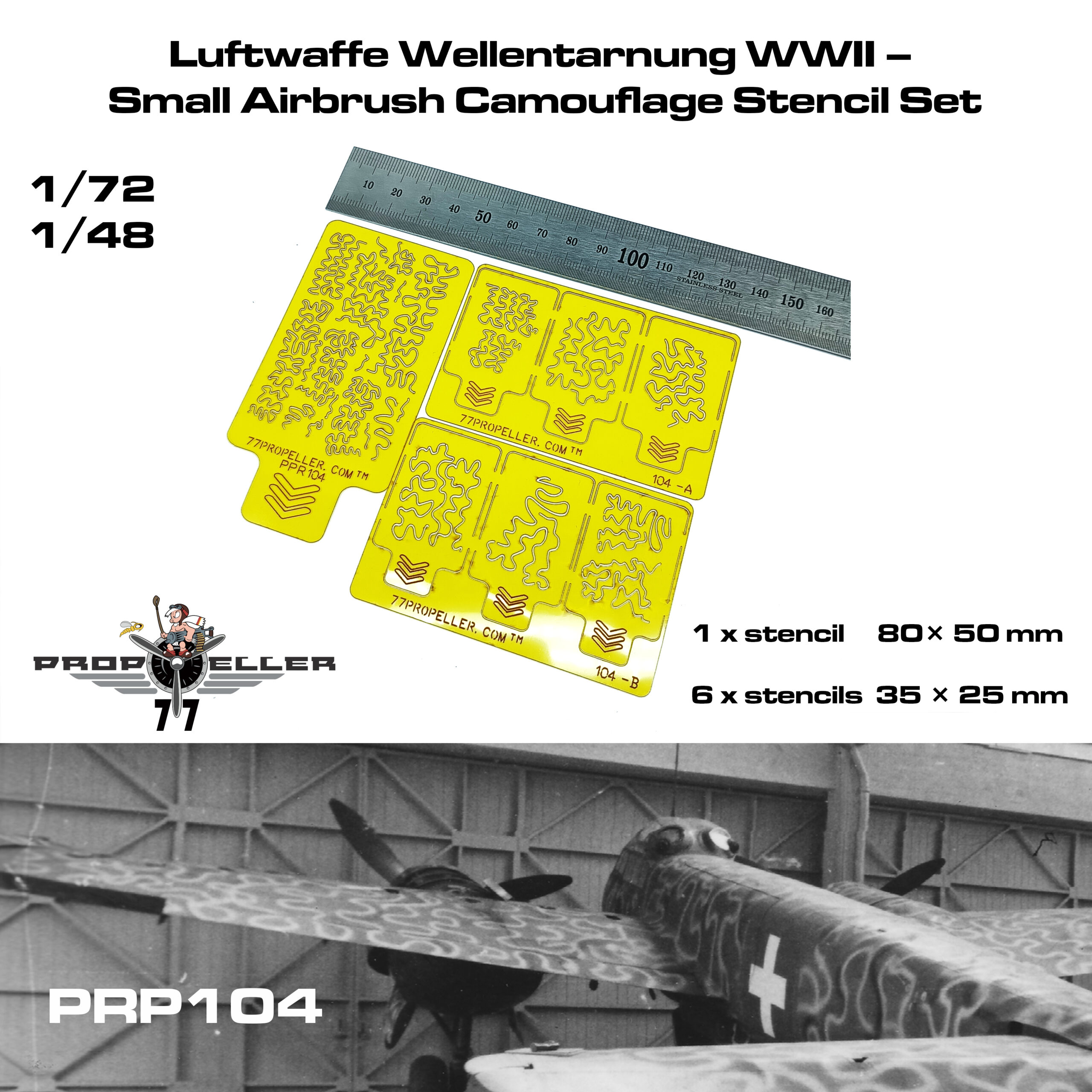
Luftwaffe Wellentarnung WWII – Small Airbrush Camouflage Stencil Set
8,00€ with VAT
Suitable for scales: 1/72 and 1/48
This reusable airbrush camouflage stencil set is designed to reproduce the distinctive Wellentarnung (wave-pattern) camouflage used on Luftwaffe aircraft during World War II.
The set features a selection of fine, irregular wave-shaped patterns that allow modelers to create realistic camouflage effects using an airbrush.
Made from high-quality, flexible plastic, the stencils can be gently bent to follow curved surfaces and are suitable for use on aircraft fuselages, wings, and other model components.
Set Contents
The set contains 7 reusable airbrush stencils:
- 1 stencil: 80 × 50 mm
- 6 stencils: 35 × 25 mm each
The combination of different patterns allows you to vary the camouflage layout and achieve a more natural appearance.
Description
How to Use
Position the stencil over the desired area of your model and secure it using Blu Tack (or a similar reusable adhesive putty) or low-tack modeling masking tape.
Using Blu Tack creates a small gap between the stencil and the model surface, allowing you to achieve soft, diffused camouflage edges. For sharper patterns, position the stencil closer to the surface.
For the best results, use properly thinned paint and apply it in several thin, controlled layers. Gradually build up the color intensity to achieve a realistic camouflage appearance without excessive paint buildup.
The flexible plastic allows the stencils to follow curved surfaces, making them suitable for spraying camouflage patterns even in hard-to-reach areas.
The stencils are reusable and can be combined with other airbrush stencils to create a wide variety of camouflage effects.
Stencil Cleaning and Maintenance
If cleaning is necessary, we recommend using technical alcohol immediately after use, before the paint has dried. Prompt cleaning helps reduce the risk of material damage and extends the lifespan of the stencil.
Avoid cleaning agents for lacquer or acrylic paints that contain acetone or similarly aggressive solvents, as these may damage or deform the plastic.
Use only cleaning agents that are compatible with plastic and do not affect its structure.
Gently clean the stencil with a soft brush and allow it to dry. Do not soak the stencil in cleaning solutions.
Proper maintenance helps preserve the stencil’s fine details, original shape, and functionality for repeated use.
Related products
-

SET “5” – 2 AIRBRUSH TEMPLATES – AIRBRUSH STENCILS MEDIUM – 110 MM x 70 MM
Add to cart -

Airbrush šablóna – Airbrush Stencils pre striekanie jemných detailov
Add to cart -

Airbrush Stencils 90 MM X 60 MM “Wood TEXTURE” for spraying fine details – scale 1/32, 1/35
Add to cart


